Among the 60 books chosen for the extensive longlist of the PT Prize, five are Portuguese titles: The Machine for Making Spaniards by Valter Hugo Mãe; Cliffs by Gastão Cruz; Ondina's Curse by António Cabrita; Triptych of Supplication by João Rasteiro; and The Dazzled Scandinavian by Alberto Xavier. Complete lists for each of the three competing genres: poetry, fiction, and short stories/chronicles.
Running until June 17, on Avenida dos Aliados.

Click to enlarge
Writer Mário de Carvalho now has an official website with everything official websites typically contain. Located here.
A library is, by definition, a space of silence. Absolute silence, allowing people hunched over books to concentrate. But if we enter the reading room and sit at one of the tables — alert, still, senses sharp — we understand that perhaps it's not quite like that. Around us, sounds multiply: coughs, footsteps, sneezes, breathing, fingers hammering on computer keyboards, buzzing, objects falling, things scraping against other things, echoes of distant machinery, the roar of a plane following its route over the roof, already descending toward the airport. "Isn't the library rather a place dedicated to 'collecting sounds'?" asks a voice in our ears.
That whispered voice — about to give us all kinds of instructions and commands — is what guides spectators/participants during the 50 minutes of The Quiet Volume, an "auto-theatre" piece created by Ant Hampton (founder of the company Rotozaza) and Tim Etchells (artistic director of Forced Entertainment) for the 'Ciudades Paralelas' festival in Berlin (2010). After passing through Buenos Aires, Warsaw, Zurich, and London, it has arrived at the National Library of Lisbon, where it can be experienced until June 9 as part of the alkantara festival programming.
SOUTHERN MOTORWAY
The speed of vehicles
is proportional to the urge to arrive.
We'll never know if vehicles
will reach the speed at which they travel,
but we sense that
in all arrivals there's a speed
circulating inside those who depart.
[Excerpts from Rogil, Volta d'Mar, 2020]
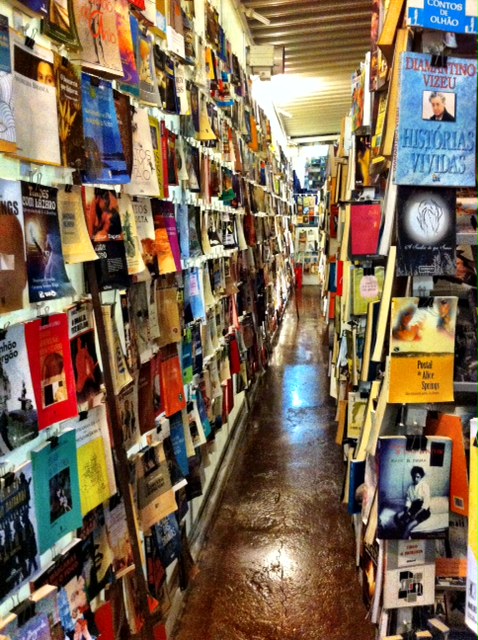
Esperança is a world unto itself.
At the hotel door, we got into a yellow taxi. The driver took a few seconds to understand where we wanted to go, then set off from Lido toward the center of Funchal. Without saying anything to each other, we thought that Esperança might be listed in tourist guides — after all, it's one of the world's largest bookstores, with an area larger than a football stadium and over 100,000 books on display — and that's why taxi drivers include it among mandatory stops for city visitors. Our mistake, of course. Reaching the center, the driver turned around, perplexed, as if he'd suddenly lost the GPS signal. "I think it's around here," he murmured. But it wasn't.
Entering Esperança is entering a labyrinth. I already knew photographs of its many rooms lined with books up to the ceiling, but wandering there is something else entirely. At every moment, we have the sensation that we won't manage to — or want to — leave that paper maze.
A Piano for Tall Horses
Author: Sandro William Junqueira
Publisher: Caminho
Pages: 360
Year: 2020
Sandro William Junqueira's second novel takes place in an archetypal City, separated from the Forest — Nature in its raw state — by an eight-meter-high concrete Wall. Inside, beyond the Government Tower and the Factory with two enormous chimneys (one to the south, where meat pies are manufactured; to the north, where the dead are incinerated), residential zones exist separated by colors and barbed wire, an "urban rainbow" that's a kind of apartheid taken to its ultimate consequences.
Vertiginous, excessive, elliptical, complex, violent, amusing, dreamlike, expansive, intelligent, visceral, full of sound and fury, baroque in both form and style, A Piano for Tall Horses is one of the most powerful, intense, and captivating novels Portuguese literature has given us in recent years.
Rating: 9/10
On a rainy morning, Juan Marsé awaited us in a bookstore in central Lisbon, where the previous evening he'd conversed animatedly with António Lobo Antunes, author of the preface to the Portuguese version of the novel Calligraphy of Dreams, published by Dom Quixote. In that short text, Lobo Antunes states about the Barcelona writer (the first Catalan to win the Cervantes Prize in 2008) that he's "one of the greatest living Spanish writers, and I don't say the greatest because I haven't read them all."
By nature and temperament, Marsé dodges such praise and attaches no importance to literary consecration. What interests him is the actual writing, the workshop labor of someone who polishes sentences with the care of a goldsmith.