Biblioteca Literaria

Pedro Eiras

Essays, reviews, and excerpts featuring the work of Portuguese writer and professor Pedro Eiras

Observing Someone Who Observes
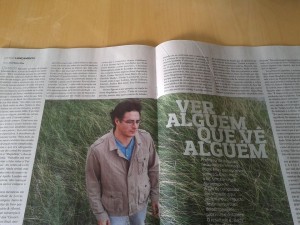
Pedro Eiras interview portrait

When Pedro Eiras speaks about Johann Sebastian Bach's music, his face lights up: "It's miraculous because it provokes things in us we can't explain. But unlike a miracle, which is unique and unrepeatable, it continues to overwhelm and move us the same way every time we hear it." At 39, this professor of Portuguese literature at the Faculty of Letters of the University of Porto, also an essayist, playwright, and novelist, knows what he's talking about—Bach's music is literally part of his daily existence.

"For over twenty years I've listened to Bach every single day. Without exception. It might be just a few minutes, it could be many hours, but it never fails. I'd have to be traveling somewhere, lost abroad, not to listen. And even then..."

A music lover since childhood, Eiras studied solfège for a year and attempted piano for six months, so he's not musically illiterate (he can read a score), but he's far from being a specialist. His discovery of Bach came relatively late: "For me, initially, he was a canonical figure from music schools, composer of very complicated, cerebral, abstract pieces that one was obligated to appreciate." Then one day his sister lent him a cassette of the Magnificat, and something like an epiphany occurred.

Pedro Eiras shares these memories in Lisbon, at a bar in the Faculty of Letters, where he came to participate in a symposium. Next to the coffee cups, a copy of the book he just released: Bach (Assírio & Alvim). It's into these 150 pages that his immense fascination with the composer converged.

The genesis of the project dates back to 2002, as explained in the final text, where we see the author rocking his daughter "in the dark corridor," putting her to sleep while softly singing an aria from the St. Matthew Passion. There's pure paternal love in this moment, a faith in music's power, "as if these notes could protect us, these small sounds, a bit of warmth between our bodies." The desire to write was born there, still without form: "I thought I'd like to write about Bach, but I didn't know how one writes about Bach."
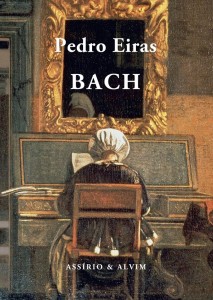
Bachian Variations

Book cover of Bach by Pedro Eiras

Title: Bach

Author: Pedro Eiras

Publisher: Assírio & Alvim

Pages: 154

ISBN: 978-972-37-1786-0

Year: 2014

In Dangerous Substances (Livrododia, 2010), a "small divertimento on literature in one hundred lessons," Pedro Eiras concluded a fascinating essayistic drift with this idea: "Literature owes nothing to what already exists: rather it opens unsuspected doors. Writing invents passages, narrow and uncertain. No one knows where they lead."

It's precisely these unsuspected doors and uncertain passages that establish the connection between the 14 chapters of this volume, substantiating Eiras's heterodox approach to the figure and work of Johann Sebastian Bach.

The project's genesis goes back to 2002, as the final text explains, where we see the author cradling his daughter "in the dark corridor," putting her to sleep while quietly singing an aria from the St. Matthew Passion. In this moment of pure paternal love there's a faith in music's power, "as if these notes could protect us, those small sounds, a bit of warmth between our bodies." The writing impulse was born there, still without shape: "I think I'd like to write about Bach, but I don't know how one writes about Bach."

Years later, he'd discover in a romanticized biography, written by an obscure British author (Esther Meynell), a certain implausible scene: Anna Magdalena Bach being moved as she secretly watches her husband in the moment of creation. If fantasy is anachronistic by nature, "then it's preferable to invent the past, to assume the pretense," incorporating into the work the investigation itself (in books, on the internet), the impasses, the failures.

Once the knot was untied, an indirect siege of the Leipzig genius emerges, through figures from various historical periods who refract, in the most diverse ways, his light. Figures united by those subtle doors and passages that literature opens or creates.

Rating: 8/10

A Brief Melody

From the street, beyond the shutters, rises the sound of starting cars. Sometimes someone calls out a name, a car honks. Soon the autumn rains will begin, and there'll be the sound of water on windows and sills, thunder, some hail, and the muffling effect rain has on city sounds. There's the silence of walls, of darkness; my footsteps in the corridor. I walk with you from one side to the other, and sing to you in a low voice: Mache dich, mein Herze, rein.

Always this aria from the St. Matthew Passion. The final aria, for bass, so solemn and intimate, with the strings so sweetly enveloping the voice. I don't know what the words mean. It would be enough to open the booklet that comes with the CD, read the text, the translations into English, into French, understand the aria's text. But I don't look for the booklet, don't open it; I don't want to know the words' meaning, just to sing it like this, in a low voice, to pour this music's melody over the silence that takes us, over your body falling asleep.

I sing in a low voice: Mache dich, mein Herze, rein. Vibration of my voice, beating of your blood, agitation in my tired eardrums from the day. And from your sleep, which begins, rises an aura of warmth. Against my chest, I feel your slower pulsations: gestures, dreams of sounds and scents, knowledge of the body—without words. You move away into that interior world, which I don't know, or which I once knew and forgot.

For me, wakefulness. Narratives, theories. Walking in the dark, thinking about work and remembering so many things, texts I don't have time to write. I think I'd like to write about Bach, but I don't know how one writes about Bach, I'll still search for many years. I think about time. I think about the painful memory of images. I think about your fragility, and the world's siege; your breathing, and the violence that pushes bodies to the void. Your fragility in my hands and the world out there against us.

But I always murmur, I continue to murmur to you, always, Mache dich, mein Herze, rein..., as if these musical notes could protect us, these small sounds, a bit of warmth between our bodies. A brief melody, in the middle of the night, all we have, all that exists in us.

From Bach by Pedro Eiras, Assírio & Alvim, 2014

Poison Without Antidote

Title: Small divertimento on literature in one hundred lessons also known by the title Dangerous Substances wherein is explained by what means books kill their readers & where are given varied and most instructive examples within reach of common mortals

Author: Pedro Eiras

Publisher: Livrododia

Pages: 211

ISBN: 978-972-8979-35-5

Year: 2010

Essayist, playwright, poet and fiction writer, as well as professor of Portuguese Literature at the Faculty of Letters of the University of Porto, Pedro Eiras bases his most recent book, Dangerous Substances (abbreviated version of a kilometer-long title), on a powerful idea, proclaimed loudly in the very first sentence: "I cannot open a book without terror: I believe that literature kills."

The hundred lessons that follow, in the form of a "small divertimento," show that Eiras's terror is far from merely metaphorical. That is, in times of postmodern softness, with easy entertainment formulas serving as anesthesia for the reading masses, what he claims is nothing less than literature's deadly power: "Some books invite killing. Others, suicide. Still others, more subtle, merely relativize death—halfway to dying. All are dangerous substances, like medications. They should only be purchasable with a medical prescription or certificate of intellectual robustness."

Having defined the poison, for which no antidote exists, the "thinking subject" undertakes a reflection in continuous drift, encompassing almost all possible declensions of his theme: not only death by writing (from the real suicides provoked by Goethe's Werther, to the punishment for reading a forbidden book, fictionalized by Umberto Eco in The Name of the Rose), but also writing about death, in Czeslaw Milosz, Bataille, Camus, Sarah Kane, Arthur Conan Doyle, Freud, Seneca, Saramago, Sade, De Quincey, among others.

What makes this journey stimulating is that Eiras assumes the essay as an infinitely elastic and absolutely free literary genre, made of advances and retreats, exaggerations and contradictions, errors and surprises, irony and play, experimentation and risk.

Rating: 8/10

The Triumph of Death (3)

I remember being at the Prado Museum and encountering The Triumph of Death by Brueghel. It was years ago, I had little time left, should be leaving, but I entered another room—and there it was. I knew that painting well, from reproductions. There it was. It actually exists.

I couldn't describe here the generalized chaos of that world attacked by skeletons harvesting, beheading, ensnaring, drowning, burying men and women of all classes and ages and professions—who, in panic, scream, flee, try to ignore the massacre. It's not even a danse macabre, but the simplest slaughter. An Apocalypse without heavenly Jerusalem.

There's much to see. In one corner, a skeleton shows a king, dressed in ermine and armor, an inexorable hourglass. Somewhere, another skeleton gropes the breasts of a plump noblewoman, while a third serves a soup of tibias and skull. In another corner, two lovers exchange melodies and words of love—immediately imitated by a skeleton, full of cynical complacency.

Why can't I take my eyes off this painting?

First, because it's the greatest massacre game I know. Without patience: death must be total—and now—and there are no excuses for anyone! Why? Well, that's how it is. Absolute synchrony, without fathers and sons, without eternity of a testimony passing on. Everything we want to see, what we always wanted—everything is given to us at once. Hallucinatorily.

Secondly, because in that synchrony there are so many quoted stories, so many anecdotes and proverbs and biblical exegeses and parodies and ironies and antitheses! The fascinated gaze never stops unveiling micro-narratives. At that level, and to return to theater, it ends up being less Sarah Kane, despite the horror, than Ghelderode: myths, fables, an imaginary that laughs at itself. That is, the pleasure of telling, of allowing oneself to be guessed. Death ceases all telling; but it itself is a source of text.

From Dangerous Substances by Pedro Eiras, Livrododia, 2010

Literature Kills

I cannot open a book without terror: I believe that literature kills.

It kills like poison in the blood. No one realizes in time to seek the antidote. Which, moreover, doesn't exist. Even stopping reading doesn't solve anything. Infiltrated, the literary poison becomes flesh of one's own flesh, to the point where no one knows anymore who thinks inside them: the illusion of an original voice, or that of the characters who entered without asking permission.

Everything invites us not to believe in that deadly power. Shop windows cram with paper printed with ink, as Pessoa writes somewhere, pretending to have nothing to do with the matter (we recognize that nonchalant tone; it's, as a rule, the murderer's). Postmodern times, it's said, these in which one reads safely. No one asks the book to kill (or suicide) anymore. Literature becomes entertainment. Requiescat in pace?

But the devil is also known, Baudelaire warned, for his final trick, the most treacherous, consisting of making us believe he doesn't exist. Perhaps literature hides, timid, under an innocent appearance. Perhaps this way it catches us off guard, therefore vulnerable. Easy prey.

Hence my terror.

No reader knows if they'll reach the end of a book: perhaps the poison will precipitate them along the way. I observe the shelves sideways, as a child fears the monster in the darkest corner of the room. I think: all these books enter me with impudence. Schopenhauer said that, when we read a book, it's the book that thinks for us. In any case, on me pense, adds Rimbaud, with or without literature. And if what-thinks-in-me discovers death? Shouldn't this make us lose sleep?

Some books invite killing. Others, suicide. Still others, more subtle, merely relativize death—halfway to dying. All are dangerous substances, like medications. They should only be purchasable with a medical prescription or certificate of intellectual robustness. Some authors, here and there, indicate in the first pages the dosage: this book only serves men who want to surpass humanity, demands Nietzsche, in his Zarathustra. The rest—may they enter at their own risk.

From Dangerous Substances – One Hundred Brief Lessons in Which is Explained by What Means Books Kill Their Readers, by Pedro Eiras, Livrododia, 2010