Biblioteca Literaria

Tagged: Edgar Allan Poe

Maelstrom

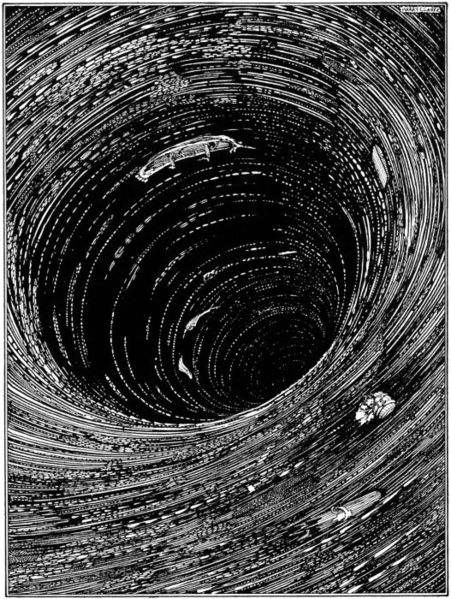
1. A vortex churns in open ocean. It's like a cosmic void, a beast with massive jaws eager to swallow four-masted ships whole. Even when inspired by real phenomena like the Moskstraumen (off Norway's Lofoten Islands), whirlpools of this magnitude exist only in fiction. The maelstrom forming there—powerful currents colliding with extreme tides—is genuinely spectacular but nothing like the apocalyptic descriptions found in Jules Verne's Twenty Thousand Leagues Under the Sea (1870, near the finale, when Captain Nemo lets the Nautilus get caught in the immense water spiral) or Edgar Allan Poe's literally dizzying 1841 tale A Descent into the Maelström.

2. Poe positions his narrator atop a towering cliff facing the Lofoten Islands, beside an old sailor who three years earlier "descended" into the maelstrom's heart and lived to tell. We soon discover this second narrator isn't actually old—his hair turned white within hours from the impact of an extreme experience "such as no mortal has ever endured." A fearless seaman, he regularly fished with his two brothers in waters few dared approach, including the maelstrom's vicinity, always escaping because they knew precisely when it formed and gained momentum. One afternoon, however, circumstances conspire toward catastrophe. An unexpected hurricane leaves them drifting within reach of the whirlpool. One brother is immediately thrown overboard while the other two watch, paralyzed with horror, as what remains of their vessel spirals down the great vortex's walls. At a certain moment, panic suspends. Aware he won't survive, hope abandoned, the sailor gains sudden clarity: "I began thinking how magnificent it was to die this way... before such a wondrous manifestation of divine power." He surrenders to the maelstrom's terrifying beauty as the full moon (appearing through a sudden break in the clouds) illuminates the smooth water walls and creates a rainbow in the vapor-saturated air deep within the whirlpool.
Maelstrom illustration

3. This detachment saves him. His remaining brother does what normal humans do. He clings to anything available, unable to reason, paralyzed by fear, ultimately going down with the ship. The survivor surprises us with his coldness and capacity to observe his surroundings. While watching, resigned, as the waters spin around an axis, he notices different behaviors among objects caught in the whirlpool. Larger ones descend faster—common sense. Less obvious is the decisive deduction: for objects of equal mass, spherical forms descend faster; cylindrical ones, slower. He grabs a barrel and launches himself into the waters, allowing him to endure long enough for the maelstrom to lose strength, bringing him back—exhausted but alive—to the sea's restored surface. Detective Dupin solved cases this way: attentive to details, deducing, reasoning. That the narrator achieves the same thing, especially under such extreme circumstances, strains imagination and plausibility. In the closing lines, he admits nobody believed his story and doesn't expect the first narrator to believe either. He's right. We readers, witnessing everything through that frightened listener's tepid gaze, never quite believe. But the story's force and overwhelming images aren't diminished because of it.

4. It's irresistible to see the maelstrom as metaphor. Chaos beyond our control that devours us. A nation in crisis, failed love, absent future. We all want to understand what might save us. The barrels are perhaps there, right before us, but we don't see them, blind to the abyss looming ahead.

[Text published in Ler magazine no. 117]


Three Ravens

The Raven, by Edgar Allan Poe, one of the most celebrated poems in English, begins with this stanza:

Once upon a midnight dreary, while I pondered, weak and weary,
Over many a quaint and curious volume of forgotten lore—
While I nodded, nearly napping, suddenly there came a tapping,
As of some one gently rapping, rapping at my chamber door.
"'Tis some visitor," I muttered, "tapping at my chamber door—
Only this, and nothing more."

A small book recently published by Relógio d'Água (O Corvo), riding the wave of Poe's bicentennial, offers translations of the poem by two of the greatest Portuguese-language writers of the last 150 years: Fernando Pessoa and Machado de Assis. Comparing both versions is interesting for what each reveals (or doesn't) about the respective translators' literary strategies.

Here's the first stanza according to Pessoa:

Numa meia-noite agreste, quando eu lia, lento e triste,
Vagos, curiosos tomos de ciências ancestrais,
E já quase adormecia, ouvi o que parecia
O som de alguém que batia levemente a meus umbrais.
"Uma visita", eu me disse, está batendo a meus umbrais.
É só isto, e nada mais."

And now Machado de Assis's version:

Em certo dia, à hora, à hora,
Da meia-noite que apavora,
Eu, caindo de sono e exausto de fadiga,
Ao pé de muita lauda antiga,
De uma velha doutrina, agora morta,
Ia pensando, quando ouvi à porta
Do meu quarto um soar devagarinho,
E disse estas palavras tais:
"É alguém que me bate à porta de mansinho;
Há-de ser isso e nada mais."

I can't resist adding a third version: by Margarida Vale de Gato, in the book launching this afternoon. Here it is:

Era o meio da noite sombria, fraco e lasso eu reflectia
Sobre os tomos singulares dos saberes ancestrais;
E com sono, cabeceando, eis que ouvi algo raspando,
Seco som, ténue, tocando, tocando à porta de fora,
Visita decerto seria, batendo à porta lá fora,
Isso só e nada mais.

Continue Reading

Reminder

This afternoon (6:30 PM), at FNAC Chiado, Tinta da China will launch the Complete Poetic Works of Edgar Allan Poe, with translation, introduction and notes by Margarida Vale de Gato and illustrations by Filipe Abranches. The book will be presented by Helena Barbas (university professor) and David Soares (writer).


Pre-Publication: 'Complete Poetic Works of Edgar Allan Poe'

In March, Tinta da China will publish the Complete Poetic Works of Edgar Allan Poe, translated by Margarida Vale de Gato. Here, in advance, is one of the poems and one of several illustrations by Filipe Abranches that will be included in the book:

The City in the Sea

Look! Death has raised its lofty throne
In a strange abandoned city,
Far off, where the Sun dies with languor,
And the good and bad, the worst and best,
Enjoy eternal sleep in that land.
There, palaces, temples, spires
(Which time has worn, but not shaken!)
Resemble nothing of ours.
Around, resigned, beneath the skies,
Forgotten by the fury of the gale,
Lie the waters still with apathy.

Poe illustration by Filipe Abranches

Continue Reading

International Poe Symposium in Lisbon (March 2009)

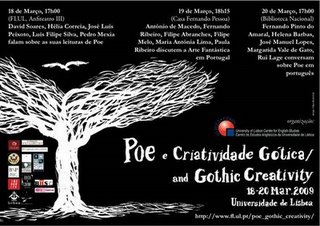
From March 18-20, the Faculty of Letters of Lisbon will host the symposium "Poe and Gothic Creativity," organized by the Center for English Studies, in collaboration with the National Library, Portuguese Cinematheque, FLAD (Luso-American Foundation) and Casa Fernando Pessoa. There will be academic presentations, debates, exhibitions (both iconographic and bibliographic), and even a Gothic party.

Here are some themes suggested in the call for papers:

Trans-Romantic Poe: Poe and other Romantic writers and artists; Poe and the Transcendentalists; Poe's sources; Poe and the 19th century Press; Poe and the Transatlantic exchanges; Poe in / out his time and place; the American Poe; the French Poe, etc.

Gothic Poe: Poe, the Gothic and/or Dark Romanticism; Poe and Horror, the Supernatural and the Fantastic; gore Poe; etc.

Pop Trickster Poe: Poe and pop culture; Poe, drugs and alcohol; Poe and literary hoaxes; Poe and novelty; Poe and humor; etc.

Continue Reading

200 Years of Edgar Allan Poe

Edgar Allan Poe, one of the greatest American writers of all time, was born on January 19, 1809. Many of his texts can be read here.

Here is Poe's most famous poem, The Raven, read by Vincent Price, Christopher Walken, John Astin, and Willem Dafoe.

[YouTube videos embedded in original]

Continue Reading