A Black Swan
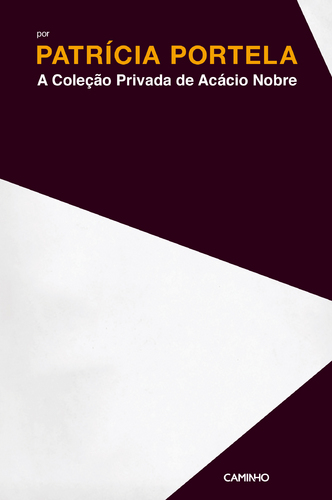
Title: A Coleção Privada de Acácio Nobre
Author: Patrícia Portela
Publisher: Caminho
Pages: 223
ISBN: 978-972-21-279-12
Year: 2026
Who was Acácio Nobre? A phantom? A quantum anomaly? An invisible man who pulled the strings of history without leaving concrete traces? Reading Patrícia Portela's latest work yields no definitive answers. Only more questions, uncertainties, provocations. The safest description: a "black swan," following the theory that all swans are white "until the moment when one (just one!) black swan appears." By existing in Portela's hyper-creative prose, Acácio Nobre becomes real. Whether he walked the earth in flesh and bone remains a minor question—perhaps an impertinent one.
The thread of this story unravels, very much in Pessoa's spirit, with the discovery of a trunk in the author's grandparents' cellar in 1999. Inside: hundreds of texts and projects from a man forgotten by History, largely by his own will. Born presumably in 1869, he traversed all the upheavals of the 20th century until fading away, nearly a centenarian, victim of a stray bullet that struck him squarely in the testicles during Paris's May '68, wandering the Quartier Latin as if strolling through Chiado, hoping to "witness a revolution before dying." Though we know only a fragment of his life through extensive gaps, it overflows with remarkable moments: he exchanged letters with Melville, crossed paths with Einstein and Picasso, befriended Pessoa and became intimate with Mário de Sá-Carneiro, survived the trenches of WWI and the PIDE files (which monitored him closely), created geometric puzzles for decades, and tried countless ways to introduce Fröbel's Kindergarten methods to Portugal, believing early artistic education was the only route to modernize the country.
The archive Patrícia Portela discovered in Acácio's trunk (a name meaning "one without malice" in Latin) is nearly as chaotic as his existence. Painstakingly, the author classifies materials, organizes them, contextualizes them, perfects the facsimiles. What emerges gradually is the image of a visionary perpetually displaced from his own time, yet somehow managing to anticipate the great ruptures and changes carried out by artistic avant-gardes—something that would certainly be inscribed in his highly inventive "genealogical tree of art," had it ever left the realm of mere intentions.
The overwhelming majority of Acácio Nobre's works aren't actually works but projects, dreams left in sketch form. Take his time machine, dubbed "Lepidóptero," which would function through "the exclusion of hours via sleep, meditation, levitation, diving flight, and metamorphosis." Or his proposal for "Chiado's re-urbanization through radical alteration of its soundscape"—an idea Patrícia Portela would materialize as an installation/performance in 2009. In a sense, Acácio Nobre only emerges from shadow through Portela's hand. She alone rescues him from an anonymity pursued almost obsessively—a will to remain unfixed in the world's order. Despite living nearly a century, no photographs of him survived (though one suspects he might appear in a group portrait found in José Pacheko's archives). During many wanderings through distant lands, taking him to Rudolstadt and Baku, he carried a heavy phonograph "to record the sound of his absence in different places." All evidence of contempt for posterity, underlined in one of the "priority objectives" of the Friends of Acácio Nobre Club: "Ensure his works remain dispersed and liable to be rediscovered and lost countless times."
That's precisely what happens while reading this enigmatic book, a puzzle worthy of Acácio Nobre's ingenious geometric constructions. We find and lose the thread repeatedly. One moment we lament not finding more examples of "minuscule art" (observable only through microscopes), the next we're thrilled by the profanity-laden account of his lover Alva, a comical example of nobility betrayed by Tourette syndrome. Or we delight in the rhetorical labyrinths of gigantic footnotes.
Fragmentary and nearly intangible, something in potentiality rather than actuality, Acácio Nobre's oeuvre doesn't exhaust itself in this challenging book. It will continue haunting Patrícia Portela's future work, from whom we hope for continued dives into the Acacian trunk, searching for notes scribbled on paper napkins and, who knows, that lost dictionary enabling us to decode a promising encrypted manifesto. But what we'd really like, though perhaps it's asking too much, is for Portela to exhume the science fiction book published by A. N. in 1902 (Memoirs of an Android Who Dreams of Electric Mosquitoes); or then the Retrospective Diary, text "in rewind, from end to beginning, with Nobre admitting that only 'by writing backwards can I confront my era.'"
One Response to "A Black Swan"
Ficção especulativa em Junho de 2026 | Rascunhos
July 10th, 2026
[…] A Colecção Privada de Acácio Nobre – Patrícia Portela – Bibliotecário de Babel | Deus me Livro | Cadeirão […]