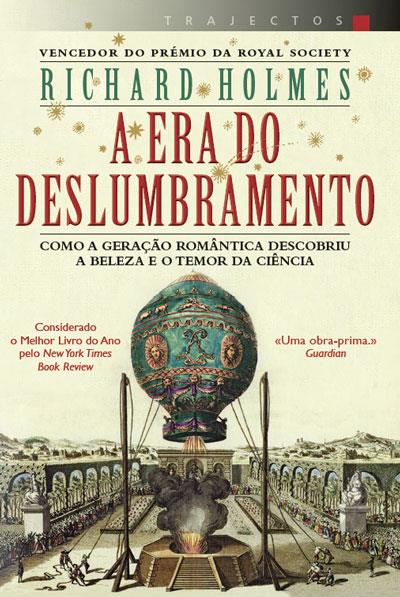
The concept of "Romantic science" might seem an oxymoron, a contradiction in terms. If Romanticism defended an ideal of subjectivity, of inscribing the self into the world, this ideal would necessarily collide with scientific objectivity. An opposition fixed by Keats in a famous phrase, saying Newton "destroyed all poetry of the rainbow by reducing it to light's effect in a prism." It's this supposed split between art and science that Richard Holmes questions in The Age of Wonder, a masterful approach to a remarkably rich period in the history of ideas, bracketed by two important maritime voyages: the circumnavigation commanded by James Cook, captain of the Endeavour (1768); and Charles Darwin's departure for the Galapagos aboard the Beagle in 1831.
For Holmes, across these six decades, what unites artists and men of science is the "notion of wonder." Discovery – whether of the natural world or a classical verse's beauty – functioning as an experience of the sublime. We lived, let's not forget, an era of transition. Africa was still an unexplored continent; the first balloons were rising into the sky; new knowledge in chemistry and astronomy expanded the universe's very horizons; learning abandoned elite salons to reach the masses through public lectures; there was in the air the seed of radical political revolutions, like the French.
More than mapping this period of astonishing intellectual ferment, the author's strategy was to narrate the lives and deeds of the main figures of the so-called "second scientific revolution," centered in the United Kingdom but with ramifications throughout Europe. Holmes proves particularly well-equipped for this enterprise because he's already published several biographies of Romantic writers like Coleridge and Percy Shelley. He lectured on Biographical Studies at the University of East Anglia and continues editing Harper Perennial's classic biography collection. The way he extracts from his sources (letters, diaries, scattered publications, listed in 12 dense bibliography pages) a true wealth of information and details, woven into an appealing narrative capable of fascinating the most reluctant readers, is exemplary in every way.
At the book's center stands the figure of Sir Joseph Banks (1743-1820). He's the pillar, the guide, a kind of "Virgil." As a young man, he embarks as botanist on the Endeavour, accompanying Cook to Tahiti on an expedition meant to record Venus's transit before the Sun in June 1769. In that earthly version of "paradise," Banks begins by collecting and classifying plants but quickly extends his interest to native people, their traditions, language, gastronomy, rites. Already in ethnologist's skin, he was the first European to witness that "strange, extreme sport so characteristic of the southern seas" that is surfing. Forever marked by the experience, he returns to London, where he'll become the longest-serving president of the Royal Society and a "universal scientific patron." Immobilized by gout attacks, he discovers young adventurers whom he finances and encourages to depart on geographical exploration journeys. Gray eminence, he maneuvered behind the scenes and managed a gigantic network of correspondents, feeding the "idea of science as a truly shared and international effort."
Though he dwells on the trajectory of many of Banks's protégés (sometimes tragic, as with Mungo Park, lost in the jungle searching for the Niger's course), Holmes pays special attention to two of them: chemist Humphry Davy (1778-1829), who discovered nitrous oxide's properties and invented a safety lamp for miners; and William Herschel (1738-1822), a German-born amateur astronomer who single-handedly built the era's best telescopes and made notable discoveries with them (an extensive nebula catalog, the planet Uranus, infrared radiation). Of all the biographical profiles the book gathers and intersects, this is undoubtedly the most impressive, revealing a figure who anticipated the universe's vision as a dynamic entity, always with discrete support in the shadows from his sister Caroline, his assistant and astronomer in her own right, whose role in science history, so often forgotten (as usually happens with women), is duly noted.
RATING: 9/10
[Text published in 'E' magazine, Expresso weekly]